 Ministry of the User
13. The stupid user

“All users are stupid.”
“Users don’t bother reading the documentation.”
“The problem is between the monitor and the chair.”
“Layer 8 problems.”
These common phrases in the realm of user experience and product development can be reconceptualized through the lenses of Carlo Cipolla and his theories on human stupidity.
The Laws of Human Stupidity according to Carlo Cipolla
Carlo Cipolla, in his essay “The Fundamental Laws of Human Stupidity”, defines stupidity and establishes a series of laws that define and explain the nature of human stupidity:
How is stupidity defined according to Cipolla?:
- Helpless: Those who cause harm to themselves while benefiting others.
- Intelligent: People who benefit both themselves and others.
- Bandits: Individuals who benefit at the expense of harming others.
- Stupid: Those who cause harm to others without obtaining any benefit, even harming themselves.
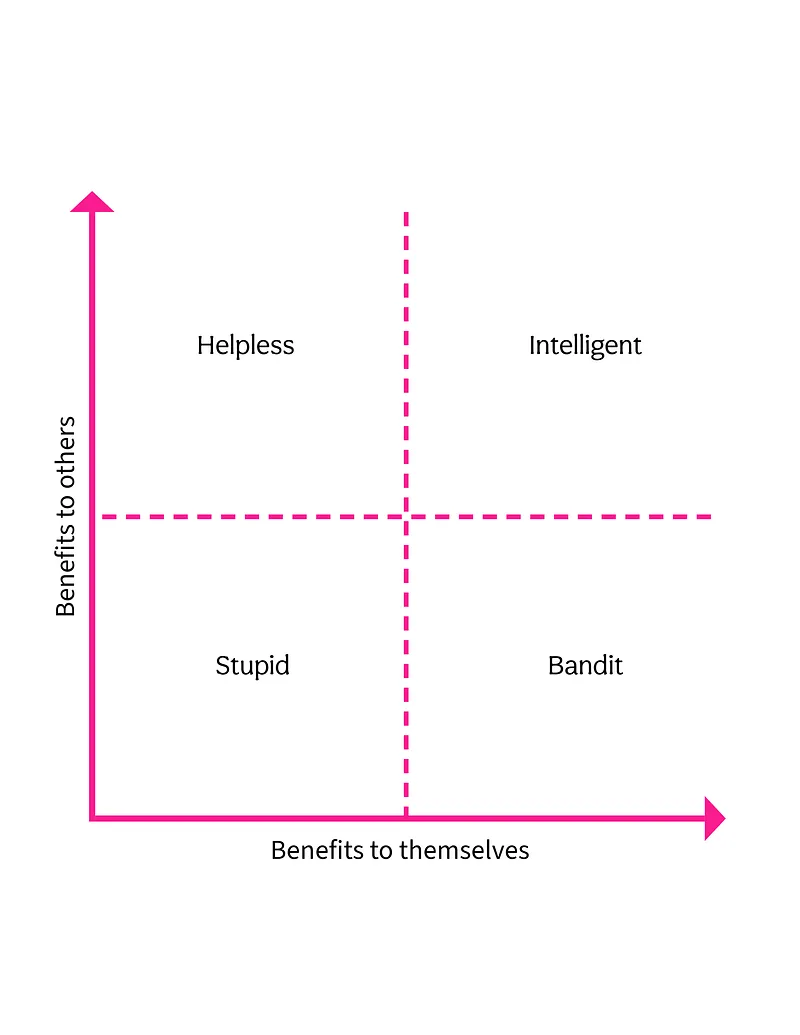
To understand how stupidity influences our daily context:
- Underestimation of stupidity: We often ignore how many stupid actions happen around us.
- Independence from stupidity: Stupidity does not depend on other qualities such as intelligence or education.
- Harm without benefit: A stupid person is one who causes harm to others without obtaining any benefit, and may even harm himself.
- Underestimating the impact of stupidity: We tend to ignore the potential harm that stupid actions can cause.
- The stupid is extremely dangerous: More harmful than the malicious due to its unpredictability.
As developers and designers, it is vital to reflect on our own position in this classification. Are we acting intelligently, benefiting both our users and ourselves with intuitive and useful designs? Or are we being gullible, harming our product with decisions that benefit users in the short term but harm the long-term viability of the product?
It’s crucial to avoid falling into the stupid category, where our decisions could harm the user experience and ultimately harm the success of our product.
Instead of dismissing users as “dumb,” we should focus on understanding their needs and perspectives. This means recognizing our own limitations and biases as creators. Users are not the problem; They are the key to effective and meaningful solutions. Adopting Cipolla’s perspective challenges us to be more empathetic, responsible and respectful in our approach to product development.