 Ministry of the User
The Cognitive Assembly Line. Post #10: The Centaur Strategy (Don’t Be a Cog)
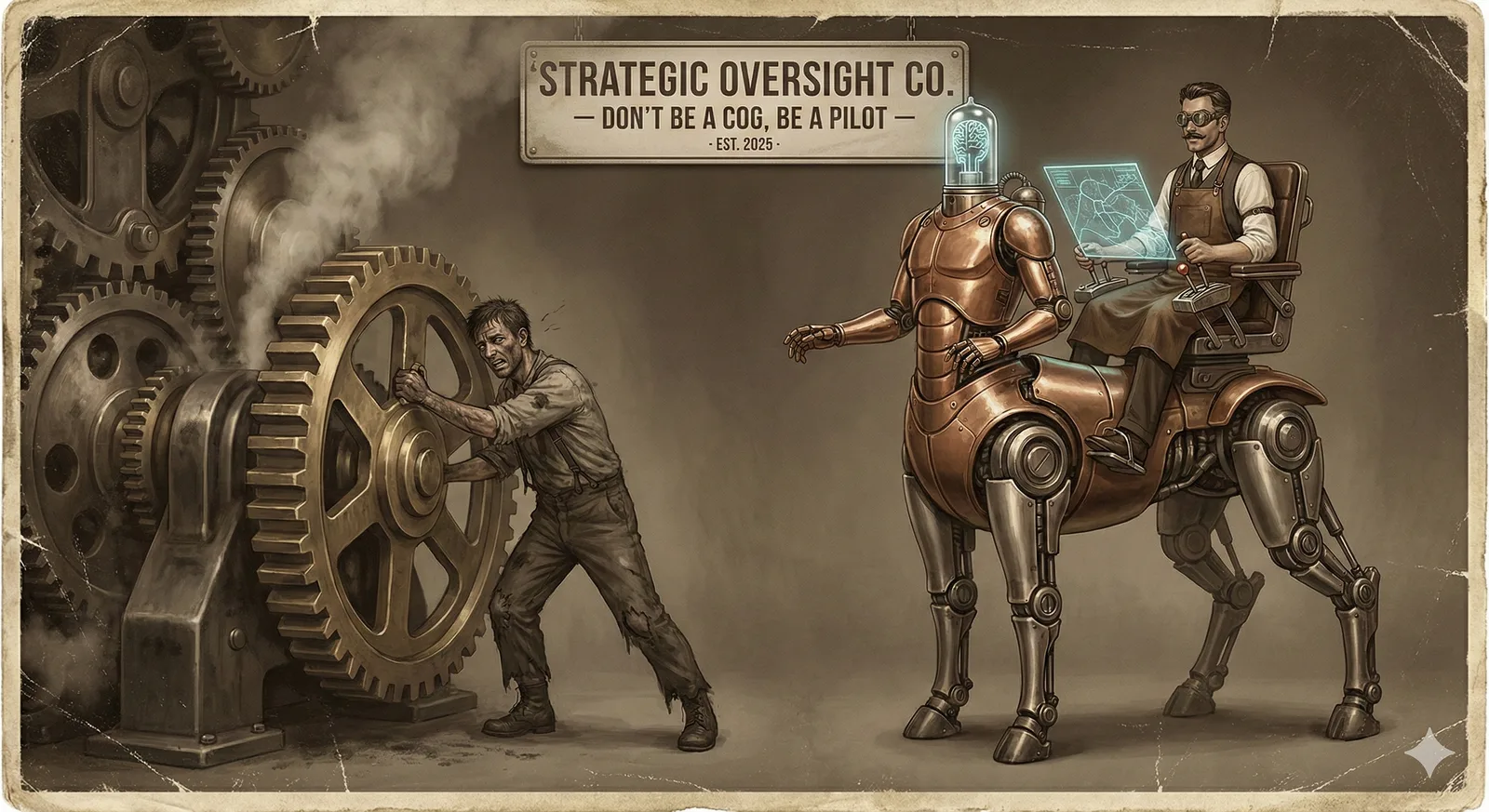
The most dangerous strategy in an industrial revolution is trying to out-work the machines. Survival requires an evolutionary leap in how we work: shifting from being the “processor” of tasks to the “arbiter” of quality, moving from brute-force cognitive labor to strategic oversight.
This happened during the Industrial Revolution
Hand-weavers who stubbornly tried to compete directly with steam-powered looms by simply working harder and longer hours faced destitution and starvation; the machine always won the endurance race. The only workers who thrived were those who abandoned direct competition and transitioned into roles the machines couldn’t fulfill: machine repair, complex custom engineering, logistics, or management.
This happens now
We have proof that competing with AI on speed is futile. The Harvard Business School “Jagged Frontier” study showed that humans trying to “out-write” the AI on basic tasks lost. However, those who adopted “Centaur” behaviors (strategically switching between human and AI work based on the task) or “Cyborg” behaviors (deeply integrating AI into their workflow loop for iterative refinement) maintained a significant performance edge. (Source: HBS/BCG “Navigating the Jagged Technological Frontier,” 2023)
This is why this is important
This signals the necessary professional shift from Processor to Arbiter. Trying to be a “faster writer” or “faster coder” than an LLM is career suicide. The only viable survival strategy is to move up the value chain: shifting focus from “doing” the initial generation to “designing” the complex inputs, “auditing” the machine’s output for hallucination, and strategically “integrating” the results into high-level problem-solving.