 Ministry of the User
The Cognitive Assembly Line. Post #12: The Universal Geek (Intolerance for Human Friction)
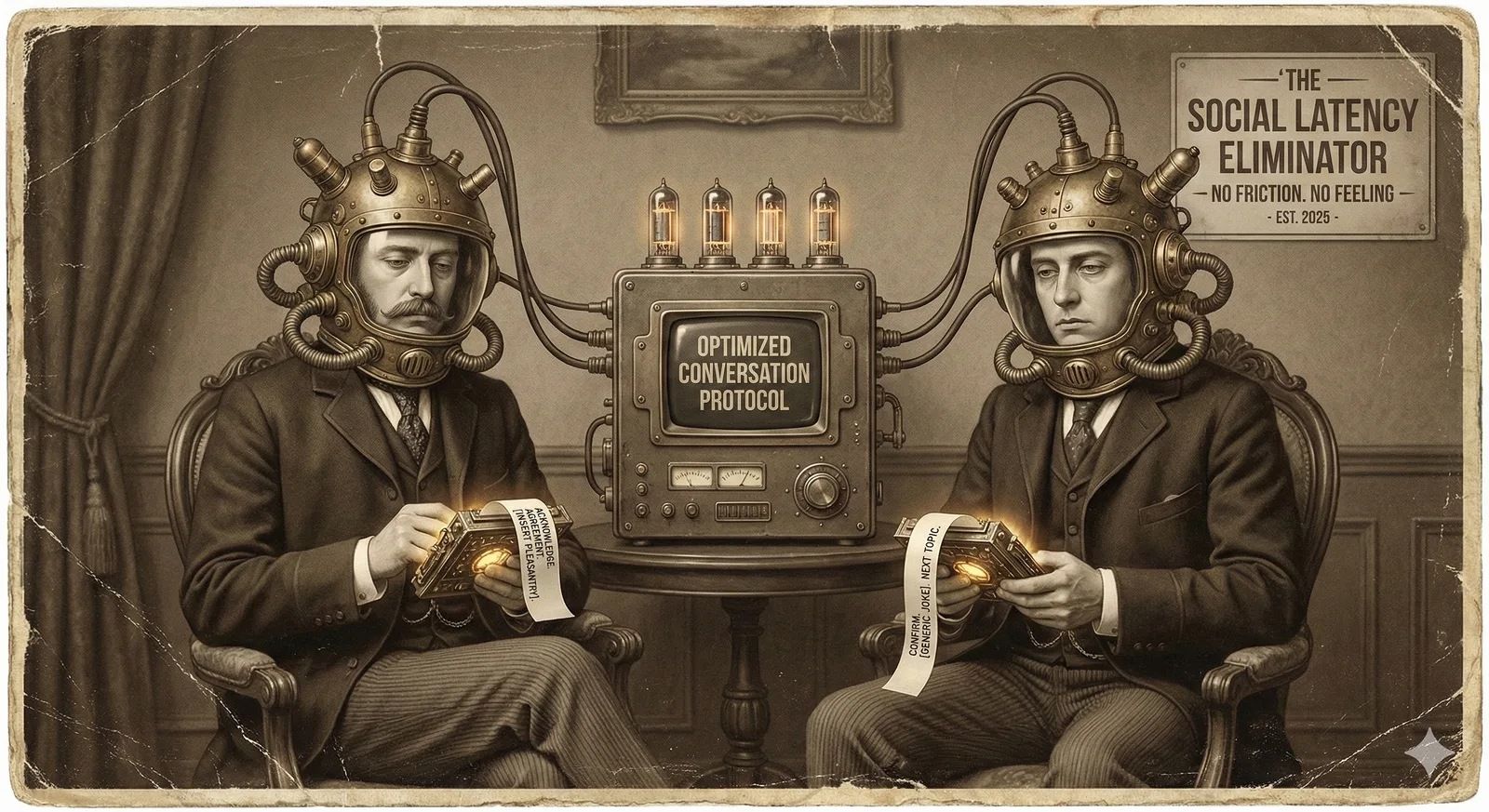
The technological mindset views human “friction” — hesitation, emotion, misunderstanding, small talk — as system latency to be eliminated. Just as the industrial era tried to “rationalize” society into cold efficiency, the AI era is outsourcing our most difficult social interactions to machines, creating a world where we are increasingly intolerant of the messiness required to be human.
This happened during the Industrial Revolution
The 19th century saw the rise of Radical Utilitarianism, famously satirized by Charles Dickens in Hard Times through the character Thomas Gradgrind (“Facts alone are wanted in life”). This philosophy sought to strip society of “fancy,” imagination, and emotional irrationality, viewing them as impediments to progress. Schools and workhouses were designed to repress the “messy” human spirit in favor of calculating, productive, biological units.
This happens now
We are using AI to “optimize” our relationships. We now use LLMs to write difficult emails to avoid the anxiety of composition, and AI summarizers to digest meetings to avoid the boredom of listening. A 2024 study by the Proceedings of the National Academy of Sciences (PNAS) found that people using AI-generated responses in conversation were perceived as more “cooperative,” but when the recipient found out the text was AI, trust collapsed instantly. We are engineering a “frictionless” social layer that feels smooth but rings hollow. (Source: PNAS, “AI-mediated communication,” 2024)
This is why this is important
Friction is Connection. Trust is not built in the seamless exchange of information; it is built in the “inefficient” moments — the awkward pause, the struggle to find the right word, the vulnerability of listening. By using AI to smooth over these rough edges, we are becoming “Universal Geeks”: capable of processing infinite data, but increasingly incapable of tolerating the raw, unpolished reality of another human being.