 Ministry of the User
The Cognitive Assembly Line. Post #7: The New Digital Landlords (Rentier Capitalism)
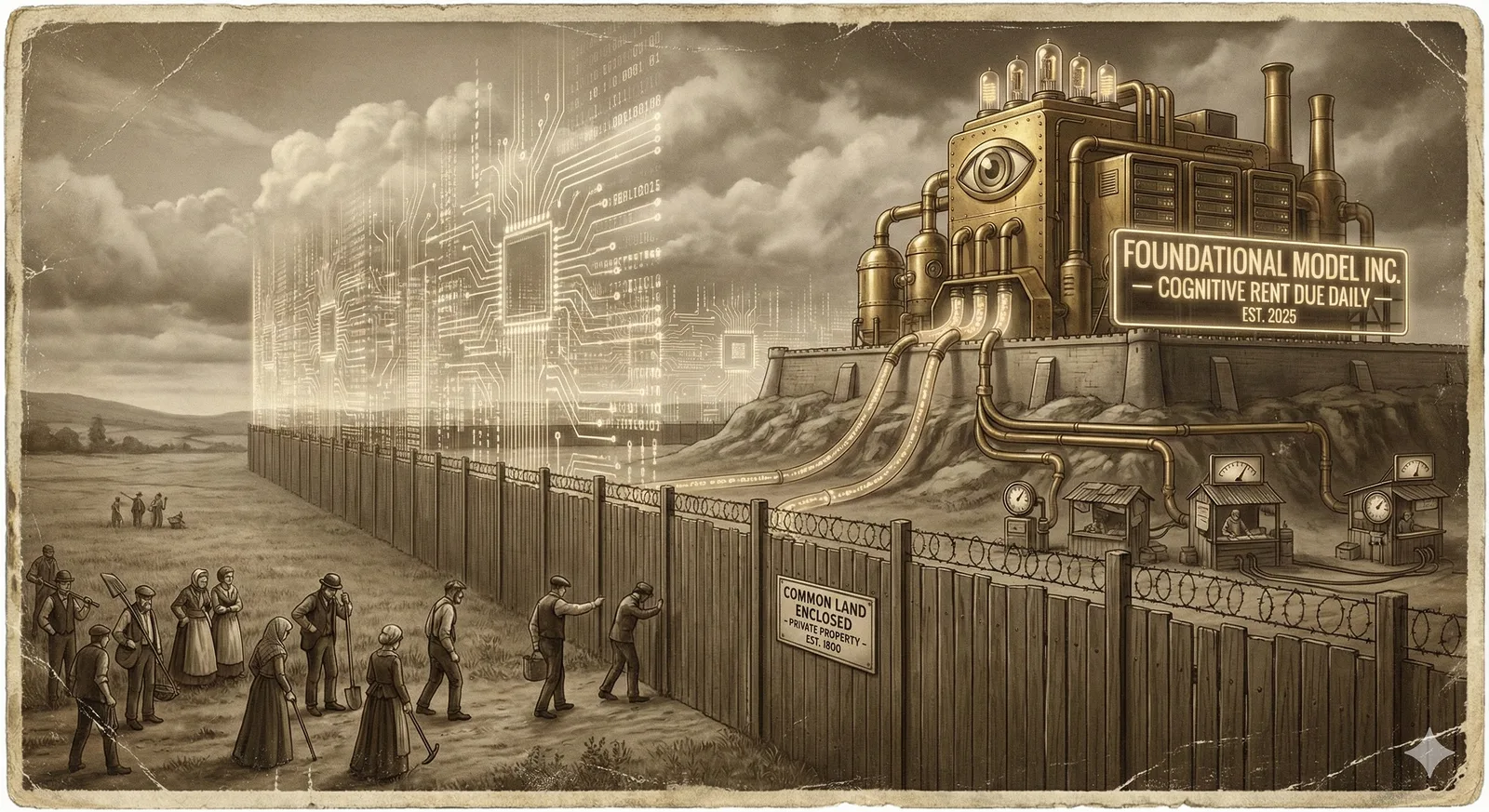
While the AI boom has created a gold rush of new startups and products, the deepest economic shift is the move toward “Rentier Capitalism.” The true winners aren’t the app developers, but the tiny oligopoly that controls the foundational models, turning every other business and worker into a digital tenant paying a toll for cognitive access.
This happened during the Industrial Revolution
The Industrial Revolution was preceded and enabled by the “Enclosure Acts” in Britain. Wealthy landowners literally fenced off lands that used to be “commons” for public use. Independent farmers, stripped of their ability to sustain themselves, were forced to become tenant farmers paying rent to the new owners, or migrate to cities as wage laborers. Wealth concentrated not just through producing goods, but through the monopolistic ownership of the essential resource: land.
This happens now
We are witnessing the “enclosure” of human knowledge into proprietary models. While many build AI apps, they are wholly dependent tenants renting API access from a handful of hyperscalers. The Stanford Institute for Human-Centered AI (HAI) reports that the compute cost to train state-of-the-art models has skyrocketed into the tens and hundreds of millions of dollars, creating an insurmountable economic moat that ensures only massive capital incumbents can own the “land.” (Source: Stanford University HAI, “AI Index Report 2024,” Chapter on Economy and Education)
This is why this is important
This is the rise of “Platform Feudalism.” If models begin to recursively self-improve, this centralization compounds exponentially, making it impossible for newcomers to catch up. Current leaders leverage their position not just by out-producing competitors, but by charging a “cognitive tax” on every startup, product, and worker that relies on their infrastructure to function.