 Ministry of the User
The Cognitive Assembly Line. Post #8: The Model T of the Mind (Mass Production of Thought)
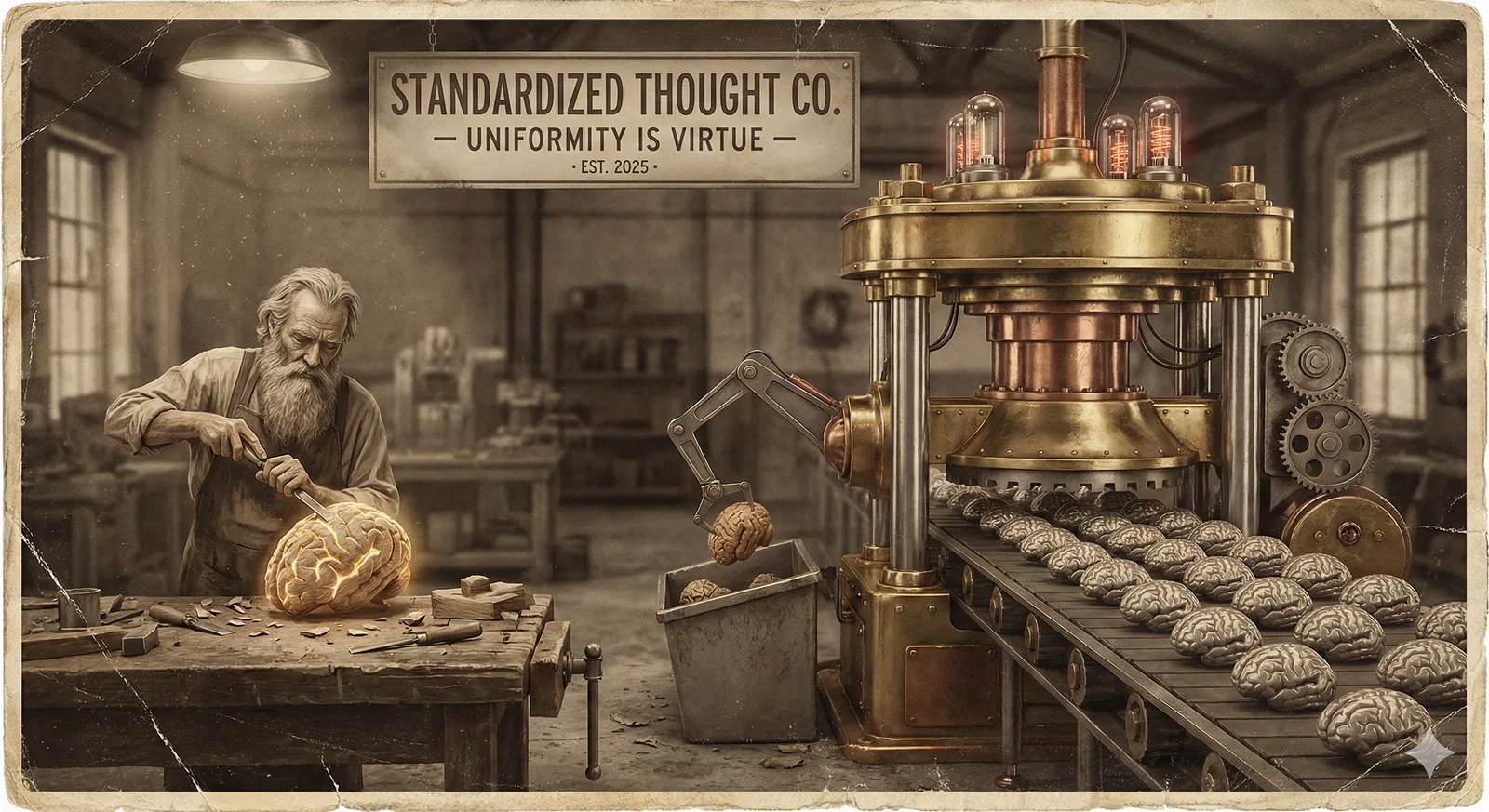
Before the assembly line, every product had quirks; afterwards, uniformity became a virtue. Today, AI is doing to ideas what the factory did to muskets: mass-producing “average” thought, smoothing out the unique edges of human creativity, and creating a regression to a standardized cognitive mean.
This happened during the Industrial Revolution
Before industrialization, a musket made by one blacksmith had parts that wouldn’t fit a musket made by another. The Industrial Revolution pioneered “Interchangeable Parts” (popularized by Eli Whitney). The goal was to eliminate the individual “quirks” of the artisan to ensure standardized mass production. Variation, once a mark of hand-craftsmanship, was reclassified as a defect.
This happens now
We are witnessing the mass production of standardized thought. A 2024 study published in Science Advances found that while Generative AI helps lower-ability writers improve, it reduces the collective diversity of content across the board. Stories generated with AI assistance were rated as more “professional” but were significantly more similar to each other than those written by humans alone. (Source: Doshi & Hauser, “Generative AI enhances individual creativity but reduces the collective diversity of novel content,” Science Advances, 2024)
This is why this is important
This signals a Great Regression to the Mean. Just as the factory standardized the physical world, AI is standardizing the cognitive world. Workers are being nudged toward a “safe,” homogenized corporate voice. The unique, eccentric, or risky ideas — the “artisan’s touch” that drives true innovation — are statistically smoothed out by the algorithm, turning the knowledge worker into an operator of a “Standardized Thought Assembly Line.”